
Press Release
3 August 2026
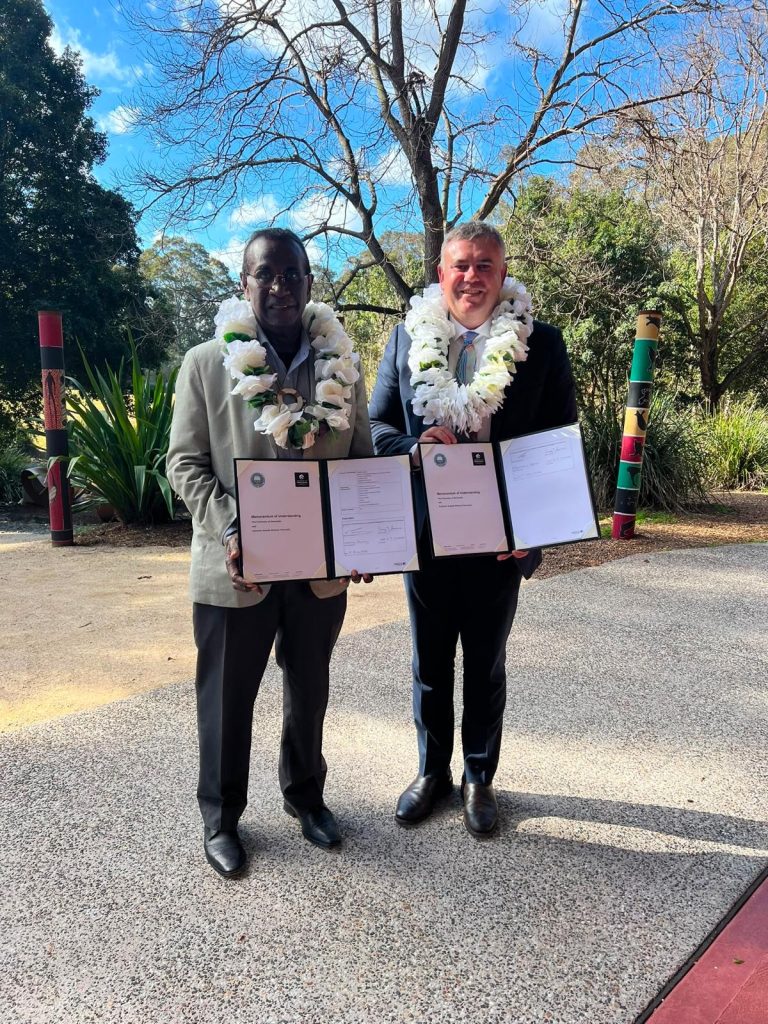
The Solomon Islands National University (SINU) has taken another significant step in advancing its internationalisation agenda following a highly successful official visit by Vice-Chancellor, Professor Transform Aqorau, to the University of Newcastle (UoN), Australia, from 30–31 July 2026. The centrepiece of the visit was the formal signing of a Memorandum of Understanding (MoU) between the two universities, establishing a four-year framework for strategic collaboration in teaching, research, innovation and institutional development.
The MoU was signed on behalf of SINU by Professor Aqorau and on behalf of the University of Newcastle by Mr Nathan Towney, Interim Deputy Vice-Chancellor (Engagement and Equity), in the presence of senior university leaders, academics and Solomon Islands students studying at Newcastle. The agreement provides a platform for both institutions to work together in research, education, knowledge exchange, staff and student mobility, and projects that directly contribute to the sustainable development priorities of Solomon Islands.
Professor Aqorau described the visit as one of the most strategically important international engagements undertaken by SINU this year.
“This partnership is about much more than signing an agreement. It is about building long-term institutional capability, strengthening our academic programmes, creating new research opportunities, and ensuring that SINU continues to evolve into a modern university that contributes directly to the development of Solomon Islands and the wider Pacific.”
He said the partnership aligns closely with SINU’s Strategic Plan 2026–2030 and the University’s commitment to improving quality assurance, strengthening research, expanding postgraduate education, enhancing staff capability, and building stronger international partnerships.
Over two intensive days, Professor Aqorau met with senior executives and leading academics across a broad range of disciplines. Discussions focused on practical areas where collaboration can deliver tangible benefits for students, staff, government and communities.
Key areas of collaboration include:
- strengthening academic quality and programme accreditation;
- research collaboration and postgraduate supervision;
- staff and student mobility;
- Indigenous and Pacific knowledge systems;
- quality teaching and inclusive education;
- digital education and student success;
- public health and nutrition;
- fisheries, marine governance and environmental management;
- engineering and technical education;
- waste management, recycling and the circular economy;
- renewable energy and climate resilience.
A recurring theme throughout the visit was ensuring that university research delivers visible benefits for society and contributes directly to national development.
Among the major discussions was the opportunity for the University of Newcastle to support SINU’s ongoing programme review and accreditation reforms.
Professor Aqorau held extensive discussions on innovative approaches to academic workload, research impact, digital education, programme peer review, inclusive education and student success.
The University of Newcastle also expressed its willingness to support external peer review of SINU programmes, provide access to teaching and learning resources, and collaborate on professional development initiatives for academic staff.
Professor Aqorau noted that, “SINU is currently undergoing one of the most significant periods of academic reform in its history. Our discussions with Newcastle demonstrated that we have found a partner willing to walk alongside us as we strengthen quality, improve teaching and learning, and build a stronger research culture.”
An important component of the visit centred on Indigenous and Pacific knowledge systems.
Professor Aqorau met with researchers at the University’s internationally recognised Purai Global Indigenous History Centre and the Wollotuka Institute, where discussions explored new approaches to Indigenous research methodologies, culturally grounded postgraduate education and recognition of traditional knowledge within higher education.
The two universities will explore the development of innovative postgraduate pathways that recognise creative practice, oral histories and Indigenous knowledge as legitimate forms of scholarly research, while maintaining rigorous academic standards.
One of the most exciting outcomes of the visit was agreement to develop a major collaborative programme in recycling, waste management and environmental sustainability.
The two institutions discussed a proposed Graduate Certificate in Recycling and Waste Management, which would build national expertise in hazardous waste management, recycling technologies, Basel Convention implementation and the circular economy. The proposal is designed around four Industrial Resource Ecology courses and follows a phased model that transfers teaching responsibility progressively to SINU, ensuring long-term national ownership.
The partnership also includes plans to:
- establish practical recycling demonstration facilities at SINU;
- develop short professional courses for government and industry;
- support implementation of the Basel Convention;
- explore engineering solutions for Pacific waste management; and
- pursue international funding opportunities for environmental education and research.
Professor Aqorau said this initiative has the potential to position SINU as a regional leader in environmental education.
“Waste management is one of the defining environmental challenges facing the Pacific. Through this partnership, SINU has the opportunity to become a regional centre for education, research and practical innovation in recycling and sustainable resource management.”
During the visit Professor Aqorau also met with Solomon Islands students currently studying at the University of Newcastle.
He expressed pride in seeing SINU graduates progressing into postgraduate studies, including doctoral research, demonstrating the growing strength of SINU’s academic programmes.
The Vice-Chancellor reaffirmed SINU’s commitment to maintaining strong links with Solomon Islanders studying overseas and creating new pathways for research collaboration, postgraduate study and future academic leadership.
While the signing of the MoU represents an important milestone, Professor Aqorau emphasised that success will ultimately be measured by implementation.
A bilateral implementation group will now be established to oversee a structured programme of work, with clearly defined workstreams, timelines and measurable outcomes. Initial priorities include strengthening programme quality, advancing the proposed Graduate Certificate in Recycling and Waste Management, expanding research collaboration, enhancing staff development and increasing opportunities for student mobility.
Professor Aqorau concluded,”the University of Newcastle has shown itself to be an outstanding partner that shares our commitment to excellence, innovation and community impact. Together, we will build programmes that strengthen our people, support our nation and contribute to the sustainable future of Solomon Islands and the Pacific. This partnership represents an investment not only in our University, but in the future of our country.”
The visit marks another significant milestone in SINU’s continuing transformation into a globally connected university, committed to academic excellence, impactful research and service to the people of Solomon Islands.
ENDS//