
Press Release
Wednesday 18 March, 2026
The Solomon Islands National University (SINU) has imported 27 new cocoa varieties from the University of Reading in the United Kingdom as part of its cocoa genetic improvement research programme.
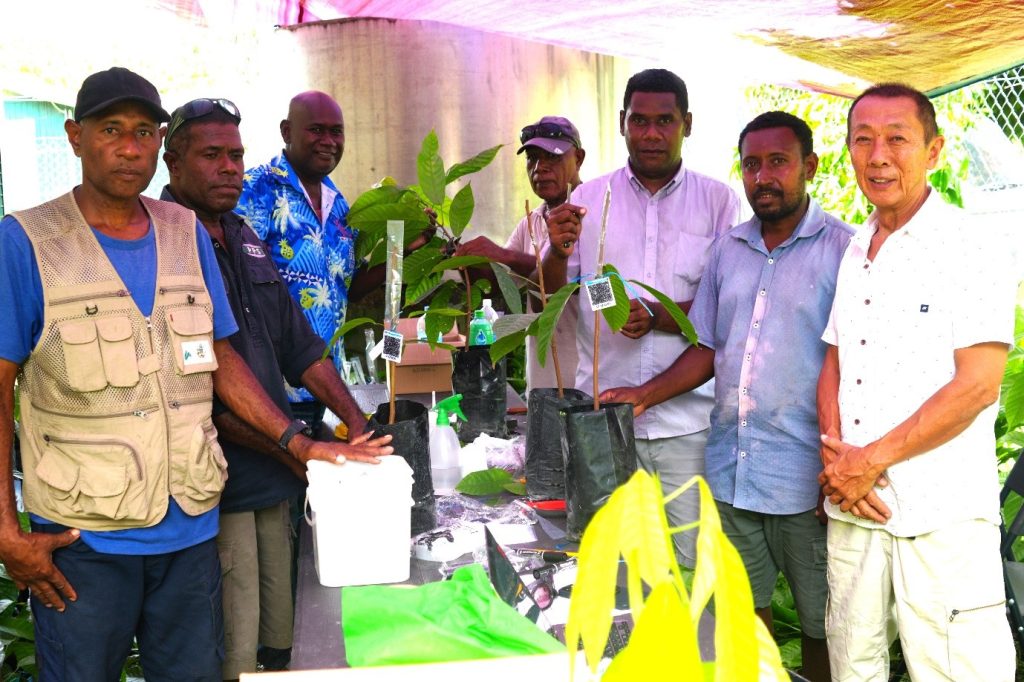
Dean of the Faculty of Agriculture, Fisheries and Forestry (FAFF), Dr Vaeno Wayne Vigulu, confirmed their arrival on Wednesday, 11 March 2026, stating that the varieties are currently held at the Ministry of Agriculture and Livestock (MAL), Post Entry Quarantine facility at Henderson for seedling grafting prior to transplanting.
The programme is a partnership between Kaprikonia Trading Company (KTC), Marist Farm, the Ministry of Agriculture and Livestock (MAL), and SINU, with the University leading the research component in collaboration with the University of Reading, UK.
Following grafting, the new varieties will be established at Marist Farm, SINU, and KTC farm before being distributed to local farmers for on-farm field adaptation studies. This initiative aims to strengthen the cocoa industry and support smallholder farmers nationwide.
Currently, farmers largely depend on traditional, non-modern varieties such as Amelonado. Although Amelonado was once considered productive and disease-tolerant, it is now widely regarded as a bulk, lower-grade cocoa variety.
Over the past 50 years, global cocoa research and development have identified superior, high-value elite cocoa varieties with enhanced yield potential.
The introduction of these modern, purpose-oriented varieties is expected to significantly improve both the quality and quantity of cocoa production.
Dr Vigulu said the programme is significant as it introduces high-quality cocoa varieties and applies grafting techniques using mature branches, enabling earlier flowering and fruiting.
He added that the programme also incorporates modern technology, with each grafted plant tagged with a QR code linked to a URL for easy access to plant information and location.
The FAFF Dean acknowledged the grafters who assisted with the grafting of the plants, including Mr Harold, a retired MAL staff member, and Mr Jeffery, a current MAL staff member.
“We would also like to acknowledge the following staff from the Department of Agricultural Studies who contributed to the grafting and labelling of the cocoa varieties in their polybags: Mr Elison Toramo, Mr Albert Rawa, Mr Carlson Tiva, and a student, Mr Casper Manelegu.”
“We also thank Professor Andrew Daymond from the University of Reading for supporting SINU with the cocoa varieties for research aimed at introducing high-quality varieties for premium cocoa markets.”
“We are currently farming the Amelonado variety, a 50-year-old variety that has already been well localised across the country.”
In conclusion, Dr Vigulu stated that improved cocoa materials are on the way, bringing promising prospects and better days ahead for cocoa farmers.
ENDS//