
Press Release
17 September 2026
The Fifth Pacific Ocean Pacific Climate Change Conference (5POPCCC) is underway at the Friendship Hall in Honiara, bringing together researchers, academics, climate practitioners, private-sector representatives, civil society organizations, and students to discuss climate change research and solutions for the Pacific.
Held under the theme “Amplifying One Pacific Voice for Action on 1.5°C to Stay Alive,” the conference focuses on research and actions aligned with the Paris Agreement and the Pacific Climate Change Research Roadmap 2025–2030.
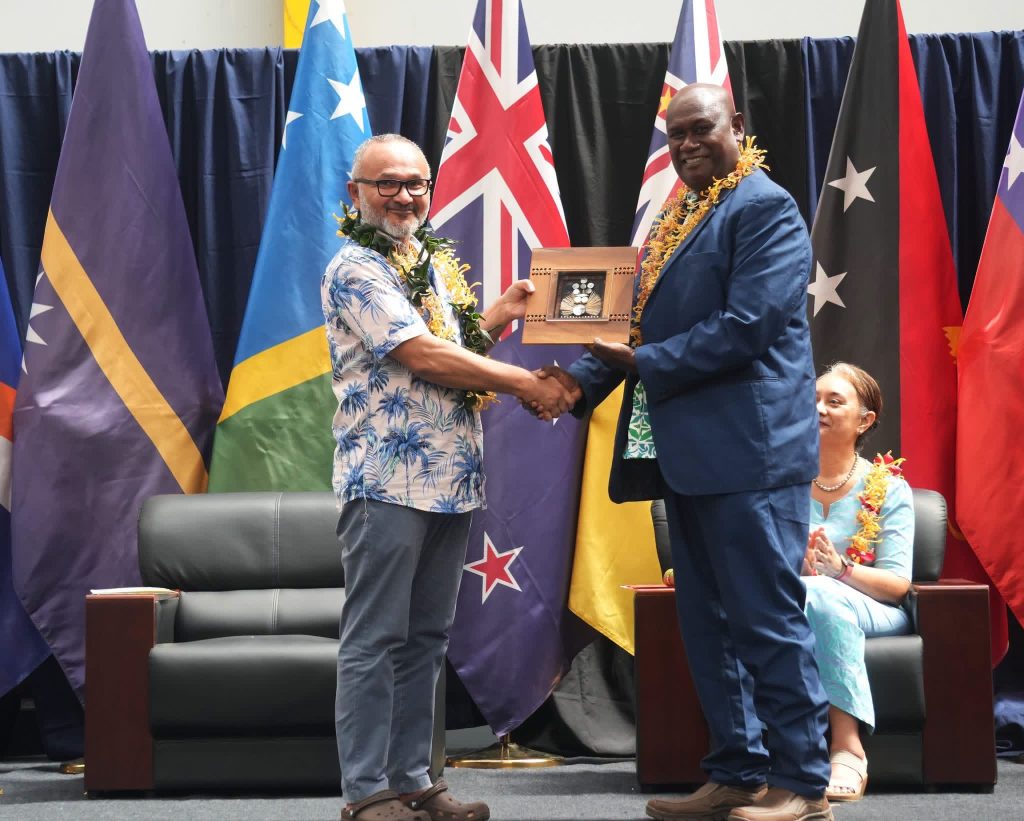
The Prime Minister of Solomon Islands, the Honourable Mathew Cooper Wale, officially opened the conference on Tuesday, 15 September, highlighting the growing impacts of climate change on communities in his constituency of Langalanga, Malaita Province.
In his address, Prime Minister Wale said communities in Auki Langalanga, and Lau Lagoon are already experiencing the effects of climate change in their daily lives.
He said rising sea levels are increasingly threatening islands, water sources, coastlines, and food gardens, creating challenges for communities that depend heavily on their surrounding environment for their livelihoods and daily needs.
The Prime Minister’s remarks highlighted the importance of Pacific-led research, collaboration, and practical solutions to address the impacts of climate change and strengthen the region’s collective response to the climate crisis.
The conference provides a platform for participants from across the Pacific and beyond to share research, experiences, and innovative approaches aimed at protecting Pacific communities and supporting climate-resilient development.
Prime Minister Wale calls for the Pacific to transform its knowledge into coordinated, measurable action and for the international community to honour its climate responsibilities through concrete delivery.
Prime Minister Wale reminded Pacific leaders that the strength of the Blue Pacific continent should not be measured by the number of meetings held, but by the difference those meetings make for future generations. He emphasized that successful implementation should be the main measure of progress, both at the conference and within Pacific regionalism.
He then called for research to be transformed into practical outcomes, including policy briefs, curricula, early-warning systems, stronger laws, finance-ready projects, and community-based solutions. The Prime Minister also stressed the importance of building lasting networks among Pacific researchers and institutions and strengthening a united Pacific voice ahead of Pre-COP31 and COP31.
The Prime Minister stated that Pacific unity was a major political asset and argued that, despite differences among Pacific nations, they needed to stand together to protect their people and ocean. The Prime Minister urged continued coordination during international climate negotiations and warned against allowing competing interests, fragmented financing, or short-term pressures to divide the region.
Prime Minister Wale said that the Pacific’s message to the international community was that the 1.5°C target should remain achievable, national climate ambitions should reflect scientific evidence, and the transition away from unabated fossil fuels should be accelerated fairly. The Prime Minister also called for adequate climate finance for adaptation and loss and damage, protection of the ocean, and recognition of the special circumstances of small island developing states.
With that, the Prime Minister emphasized that future global climate action should be judged by measurable results, including whether finance reached vulnerable communities, adaptation was implemented, people became safer, loss and damage was addressed, and emissions were reduced. Prime Minister Wale concluded that declarations were important, but their true value depended on the measurable changes they produced.
The Chair of the Fifth POPCCC Dr Vaeno Wayne Vigulu in welcoming the delegates emphasized that the conference should go beyond discussion of climate change to focus on realistic and ambitious climate action. Dr. Vigulu called for greater investment in innovative climate solutions and research that responds to the needs of communities and informs practical action.
Dr. Vigulu also highlighted the importance of deepening partnerships among researchers, institutions, communities and development partners, while strengthening pathways to climate finance. He noted that stronger collaboration, relevant research and improved access to financing are critical to turning climate solutions into tangible and lasting outcomes for communities.
SPREP Deputy Director General Ms. Easter Chu Shing, in her opening remarks, invited participants to support the Pacific Islands Forum Leaders’ commitment to urgent and inclusive climate action, reaffirmed at the 2026 Palau meeting. She highlighted the Leaders’ recognition of climate change as the single greatest threat to the security, livelihoods and wellbeing of Pacific peoples.
She also emphasized the B.E.L.A.U. Declaration for Urgent and Inclusive Climate Action, which reaffirms the Pacific’s commitment to keeping the 1.5°C goal within reach, strengthening national climate plans, accelerating a just transition from fossil fuels, improving access to climate finance, and advancing the ocean-climate nexus, youth leadership, gender equality and intergenerational justice.
Dr. Emma Dunlop of Victoria University of Wellington reminded us that the conversation about climate change is not solely about our vulnerability, but also about our resilience.
“We are peoples of extraordinary knowledge—knowledge about our environment, knowledge about our communities, knowledge accumulated over generations, and knowledge that can help shape the future of our region, and indeed our planet.
POPCCC is where Indigenous knowledge, contemporary science, technology, and innovation come together—not with one displacing the other, but through the creation of new knowledge that is richer, more holistic, and better equipped to serve our peoples, our nations, and our planet.”
The Fifth POPCCC is jointly organised by Solomon Islands National University, the Pacific Climate Change Centre of SPREP, the Solomon Islands Government’s Ministry of Environment, Climate Change, Disaster Management and Meteorology, Te Herenga Waka Victoria University of Wellington and the National University of Samoa, continuing a lineage of Pacific-led gatherings held in Wellington in 2016 and 2018, online in 2020 and in Apia in 2024.
The Fifth POPCCC, which started on Monday, 14 September, will end on Friday, 18 September 2026.
End//